Improving the Storage Customer Experience
Summary
SpareFoot, a B2C online marketplace to book storage units, had a key performance metric of move-in rate. It had been steadily declining over time, but the organization lacked clarity on why consumers were abandoning reservations and how to fix it.
Through defining the key audience for their service, review of consumer feedback data, and an exploratory qualitative study, I was able to define the cause of the issue, provide scale to prioritize fixes, and propose solutions.
This work gave the organization clarity on how our current digital experience worked with the consumer’s real world experience, exposing the gaps to key stakeholders. It went on to define how we positioned products, drove cross-sells, and communicated with our customers to drive success.
Challenge
When a consumer moves into a storage unit they booked on SpareFoot’s online storage marketplace, the corresponding facility pays SpareFoot for the new customer. This is a primary driver of revenue for SpareFoot.
However, more and more customers were abandoning their reservations and move-in rate was steadily declining. At the time, only 42% of customers that booked reservations with SpareFoot actually moved in.
Research shed more light on the issue to define actionable solutions.
The challenge for me as the lead on this project was :
Define the target audience and their current journey
Identify opportunities for us to drive success for the customer and our business
Design targeted improvements in collaboration with key stakeholders
Process
Defining the Audience
The organization had previously struggled to define their audience because they felt “anyone could use it.” Young lawyers, retired teachers, middle-aged accountants; it was not confined to a certain profession or age group.
Before I even began recruiting, I needed to define that moment when a person says, “I need storage.”
Through current consumer data, internal stakeholder workshops, and industry reports, I synthesized what we as a company knew. I had found that a large amount of customer motivation behind storage needs are the life event of moving. Another common motivated group for storage was people living in large cities with expensive real estate. In those situations, hanging on to stuff had a clear price tag attached to it.
Once I put a number behind the potential population of these two groups it was clear that these were cohorts my company should serve. I built out two recruiting profiles and created screeners for a 3rd party recruiter to get participants.
After crafting a discussion guide and conducting interviews, I engaged in affinity diagramming of key interview details to establish common patterns and characteristics among these cohorts to formulate personas.
What I found among these two groups is that all had been motivated to use storage because of a move. So all personas were movers, but their constraints and needs varied. Altogether, there were 4 personas, split into 2 groups: convenience-oriented and budget-oriented. Among other things, this defined what kind of services they would be motivated to engage in.
The personas were visualized in coordination with another designer, presented to the stakeholders for feedback, and later distributed to the company at large to create organizational understanding and empathy.
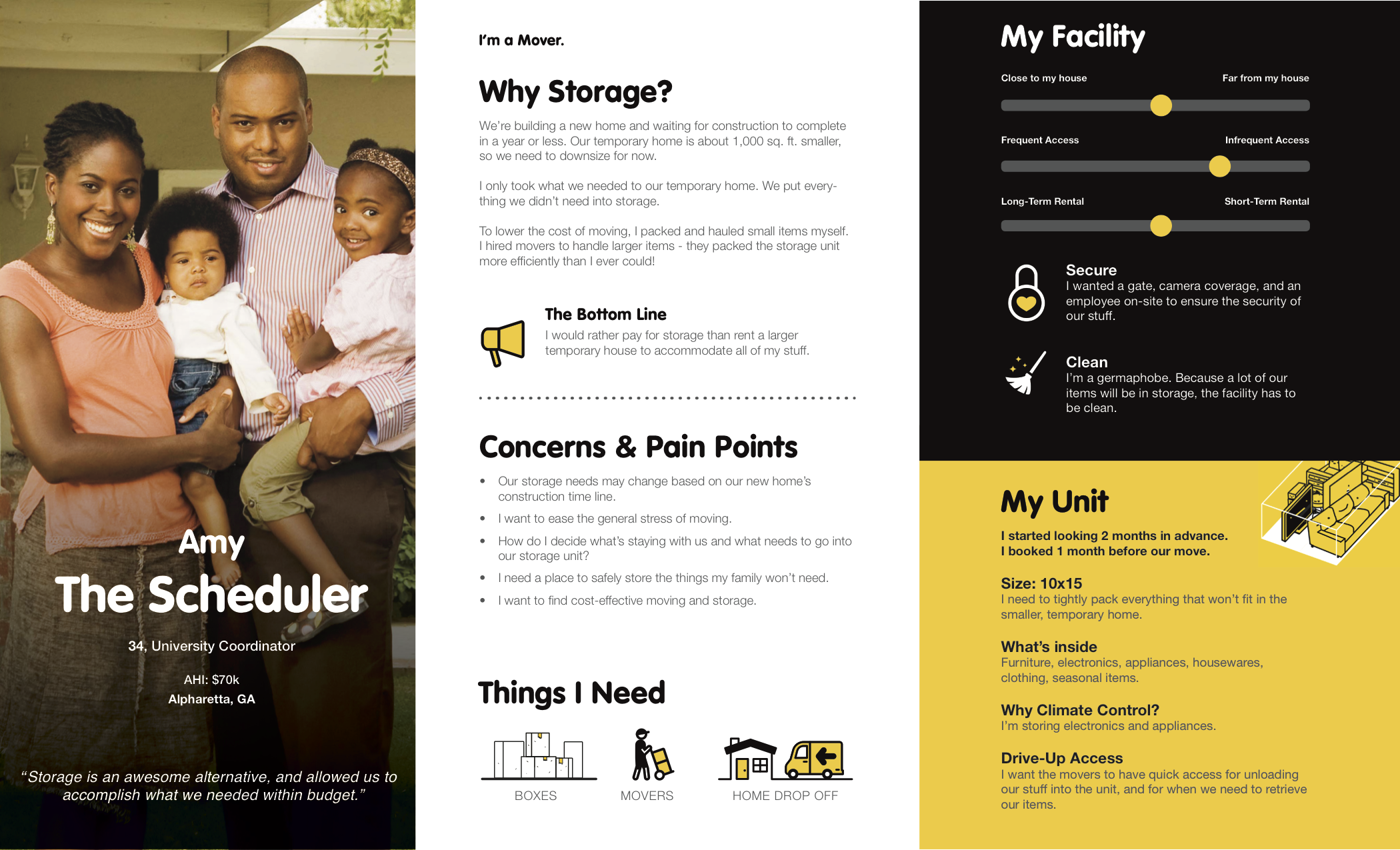
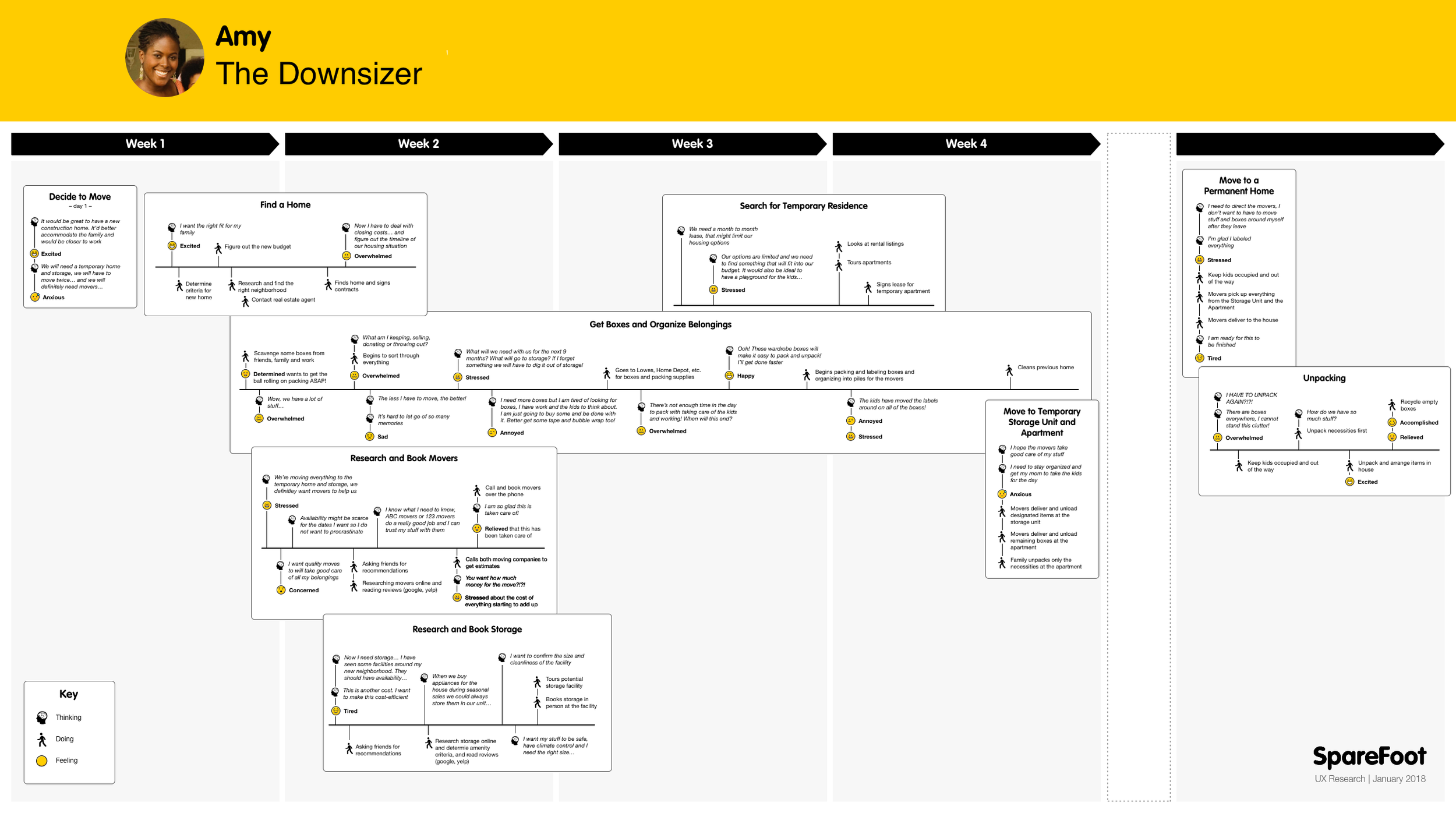
Then came the next challenge: consumer journey maps. The Product team and I agreed we wanted to to contextualize the personas into the actual journey of moving: how did they choose services, when and why? This would help with getting them the right products and positioning them well within our online experience.
I tweaked my screeners to reflect the characteristics of my personas and began recruiting. After pulling highlights from the interviews and synthesizing, I was ready to work with the design team to create the final artifact.
What was an exciting challenge about these journey maps is that people were multi-tasking throughout. It was not a nice, neat journey with one step at a time, but people juggling multiple tasks at once. If you think about any moving experience you’ve ever had, you know that it can be a stressful, messy process.
Identify opportunities
My review of consumer feedback channels month-to-month was the next step in adding definition to how we could better serve our audience. When asked through open text email follow ups why they did not move in to their unit, consumers stated the following reasons for abandoning their reservations:
Their move in date had changed and they weren’t able to update it on our site
Their priorities for distance or price had changed, and they booked elsewhere
They had an issue at the facility when they had tried to move in
The unit was unavailable or not as promised
The price they had booked the unit for was not honored
Because SpareFoot is a marketplace with a variety of storage unit options and prices, all of these issues could have been potentially fixed if they had contacted customer service. SpareFoot had a fantastic customer support call center, but customers didn’t seem to be aware of it. Only 5% of calls to the call center were a consumer that needed help with an existing reservation.
Though shocking to internal employees, reviewing the site and post-reservation communications clearly showed that SpareFoot did not publicize our customer support capabilities or how to contact customer support. This hurt move-in and our brand image. When consumers are moving into a storage unit, they are typically juggling many other life events at the same time. We were causing a stressful situation to be even more stressful because they could not find a home for their stuff due to us not communicating how they could find support.
This was driven home to stakeholders in the consumer journeys. Stakeholders voiced that seeing the journey made them realize that we focused very hard on getting consumers to reserve on the site, and then did very little to support their actual move-in.
It was clear from the research that consumers did not consider their journey with SpareFoot over until they moved in, yet our marketplace was not supporting successful completion.
I had been publishing these issues in the monthly newsletter and presenting them at the monthly company meeting. Though the product group agreed that I was finding some issues that had to be addressed, because we had limited resources, I needed to provide scale to the issues before they could prioritize fixes.
I worked with email marketing to launch a post-move in survey for customers who had not moved in. After we received 2,000+ responses, we had numbers.
43.7% had difficulty changing their move-in date
32% had a change in priorities and had not reached out to see if we could rebook to meet their needs
11.7% had an issue with the facility when they arrived to move in
Only 4.3% no longer needed storage. This told us that there were a lot of opportunities to save these reservations, but because people were not aware of the value or the customer support we offered, they did not contact us.
Product and I agreed that the onsite reservation funnel and post-reservation communications had to have stronger messaging about our value and available customer support. A colleague and I sketched a concept to display pieces of information that I had seen consumers needed, and she completed a high-fidelity mockup.
We decided to test the concept in an exploratory qualitative study with 12 participants. Due to high volume of work at the time, I designed a test plan in collaboration with 3rd party research vendor who then went on to facilitate the session. I invited the product group to watch sessions remotely so they could benefit from the sessions.
In addition to testing the post-reservation communication concept, we wanted to find out customer preferences for communication channels (e.g. email, sms, etc) and reactions to our competitors’ and indirect competitors’ email communications to expose additional opportunities.
We found that:
Designing for stressful situations was key
Our consumers would be driving truckloads of items to take into storage on their weekend. They would be busy, stressed, and ready to get it over with. If something went wrong, it was critical that they knew that they could contact us to fix the situation
Therefore, consumer support messaging needed to appear in outlined parts of the funnel, as well as prioritized in hierarchy of the confirmation and reservation reminder email.
Storage consumers had a preference for email
It had details all in one place and was easy to find later
SMS was seen as a secondary complement to email
There were positive reactions to our email design concept
Participants appreciated the flow, clear section headers, and prioritized content
We also had direction on:
Expectations around content in the storage confirmation email
Perception of different pieces of content in the post-reservation communication flow
Outcome
We now knew that our primary audience was female, going through the process of moving, and juggling multiple tasks and needs. We had a clear picture of why they paid for services, and when they began looking at them. We knew that in order to provide a good consumer experience, we had to make this potentially stressful process easy and the consumer journey maps told us how to do that.
This was such an important process for the company that had previously been unable to understand their consumers. Among other things, this process exposed that the current experience focused very hard on getting reservations, but once the consumer left the site, SpareFoot did not do a good job of supporting the successful completion of moving into a storage unit, much less getting the consumer to engage in other services we offered. The journey maps did a fantastic job of highlighting these gaps to stakeholders and getting them thinking about opportunities for a better consumer experience.
Personas and consumer journey maps informed:
The language and positioning of products
Ad targeting
Concept exploration
Study and testing recruitment
Organizational empathy
Cross-selling efforts
Re-capture efforts
Improved post-reservation communication designs were rolled out along with SMS communications. We planned to track engagement with customer support for post-reservations issues and monitor how that affects move-in rate
The survey that goes to customers that did not move in will continue to run and provide scale to issues. Along with the KPI of move-in rate, the survey will reflect the impact that these post-reservation communication efforts have.